Thursday, April 15, 2010

What I Found Out


"St. Dorothy, Patron Saint of Gardeners, Buries Land Developers to Make Room For A Field"
7"x8" acrylic on paper

I don't believe in statistics. I just don't believe in them.
I don't believe that the bad things people do to each other have to happen. I don't believe violence or dumping toxic waste in a river are probable based on sheer numbers. Pick any one of those numbers and you will see a whole chain of decisions that were made, perhaps even generations before the incident of child abuse or environmentally caused cancer occurred, you will see individuals making choices. Assuming these events are just the roll of the dice or somehow inevitable allows us to abandon our responsibility to each other and to our planet. There may be reasons why people do what they do, but they are not excuses. Excuses let us off the hook, but understanding the reasons allows us to effect positive change.

My rejection of our dependence on statistics is the result of 40 years of struggling to understand the nature of evil. I grew up in the very incubator of American bad behavior-the middle class suburb.
I never felt comfortable here. I was very aware that I didn't "fit in": my weird last name, my hand me down clothes from a sister who was several years older, my autistic brother. More than that, though, was the awareness that others suffered and I did not. It was personal in the case of my brother: why was he autistic and apparently doomed to a terrible life, why not me? Couldn't it just as easily have been me? I felt guilty for getting off scot-free. As for the rest of the world, I had seen the plight of Cambodian refugees and terribly malnourished African children on the news, I had read enough books about children during war time. I somehow knew I was living in an illusory bubble in which people were focused on things like having designer labels on their clothes, and that somewhere else at that same moment other people were in grave danger. It was the unfairness of this arrangement that troubled me. I could not have expressed it in words, it was a feeling, a feeling that I was enjoying safety that I wasn't entitled to, that I didn't deserve, yet here I had it and other people didn't. Why? Why? It drove me nuts for years.

Fortunately, among the gifts afforded to me in adulthood is faith in a loving God, and the knowledge that I'm not any better or any worse than anyone else. What a relief. I know for a fact that every single person who shows up on this planet is loved by God, from the baby who barely gets to draw a breath because she was born in the midst of a famine in Ethiopia to the Emperor of Japan, we are all loved. We all deserve to live in safety- whether we get to or not is an accident of birth. And that still isn't fair: that Ethiopian baby didn't have to die, neither did the victims of Union Carbide in Bhopal India, or Karen Silkwood, or Reverend King, but it isn't God's doing, it's the direct result of humankind's shortcomings, the dire consequences of our hubris and our miserable failings. So the question for me next became: are we all so completely broken that this can't ever be fixed?

It occurred to me long ago--as I observed the "norms" of middle class America with bafflement--that just because something is "the norm" doesn't mean it's normal, or even a good idea to begin with. The very institutions we made that condition how we think and perceive ourselves in relation to the world, and that dictate our social and economic structure are directly causing much of the suffering in the world. But how to resist the seemingly inescapable pull of the social/political/economic moral black hole that is just "business as usual" in the United States: driving and polluting, working far too many hours so we can buy things that are produced at the cost of human life and health, eating food that is so far removed from nature it maybe shouldn't be called food, every dollar spent funneled into a large corporation that is murdering the poor and killing the environment? Why are we as a nation driven to be like gerbils on a wheel that never stops? Why are we so technologically advanced and yet so spiritually under developed?

Well, seek and ye shall find: last year I picked up a back issue of the excellent Orion Magazine and read an eye opening article titled "The Gospel of Consumption" by Jeffrey Kaplan. This illuminating history of the birth of American consumer culture answered some of the questions, born of helpless frustration, that have dogged me for years upon years. Kaplan writes:

In a 1927 interview with the magazine Nation’s Business, Secretary of Labor James J. Davis provided some numbers to illustrate a problem that the New York Times called “need saturation.” Davis noted that “the textile mills of this country can produce all the cloth needed in six months’ operation each year” and that 14 percent of the American shoe factories could produce a year’s supply of footwear. The magazine went on to suggest, “It may be that the world’s needs ultimately will be produced by three days’ work a week.”

Business leaders were less than enthusiastic about the prospect of a society no longer centered on the production of goods. For them, the new “labor-saving” machinery presented not a vision of liberation but a threat to their position at the center of power. John E. Edgerton, president of the National Association of Manufacturers, typified their response when he declared: “I am for everything that will make work happier but against everything that will further subordinate its importance. The emphasis should be put on work—more work and better work.” “Nothing,” he claimed, “breeds radicalism more than unhappiness unless it is leisure.”


By the late 1920s, America’s business and political elite had found a way to defuse the dual threat of stagnating economic growth and a radicalized working class in what one industrial consultant called “the gospel of consumption”—the notion that people could be convinced that however much they have, it isn’t enough. President Herbert Hoover’s 1929 Committee on Recent Economic Changes observed in glowing terms the results: “By advertising and other promotional devices . . . a measurable pull on production has been created which releases capital otherwise tied up.” They celebrated the conceptual breakthrough: “Economically we have a boundless field before us; that there are new wants which will make way endlessly for newer wants, as fast as they are satisfied.”

-Jeffrey Kaplan "The Gospel of Consumption"
Orion Magazine May/June 2008


Finding out that our soul-sucking, resource draining, money driven way of life is just a big trick perpetrated with malice of forethought by a bunch of rich industrialists was such a relief. It means that it doesn't have to be this way. Stop the gerbil wheel, I want to get off. And that equally culpable partner in crime, the United States government?

Well, this year I have been reading "A People's History of the United States" by Howard Zinn. I had long been aware that what I was taught in school about the founding of the United States was a load of happy horseshit, but this book really reveals the the dirt, and dirty it is. From the murder of the Arawak people by Columbus to the deliberately constructed architecture of racial discrimination that allowed the depraved, barbaric treatment of kidnapped African men, women and children caught in the American system of slavery, to the classist economic privilege that existed from the time the first European set foot on this continent, this book is answering all of my questions, born of years of disappointment, mistrust, and disgust, about why our government is so broken and corrupt. Why are lobbies allowed to exist? Why are our elections privately funded, effectively shutting out everyone but the rich from running for office? Why are the interests of corporations set above the good of the people and the environment time and time again? Why is there such a disconnect between our ideals and what actually happens? It turns out that our "founding fathers" were all a bunch of rich guys who wanted to protect their wealth from the king of England. Our purported ideals were what they waved around to get everyone who wasn't rich to help them out with the revolution. It worked, and they structured their new government to first and foremost benefit their business endeavors and real estate schemes, and to protect their wealth and privilege. Oh.

And yet, a relief still, because it doesn't mean that Americans are too inept to run a healthy, fair system of governance, just too greedy and self-interested to actually create one in the first place. Ineptness may not be curable, but I'm enough of an optimist to believe that greed and self-interest are choices. Knowledge is power, and finding concrete answers to the questions that have plagued me has allowed me to examine my own role in our current system, think about solutions, and try my best to change what I don't like about my own behavior.

And if we don't decide to change? I don't know about you, but I can feel the wobbly, reckless, blinding speed of our downward trajectory. I've been expecting a crash for a long, long time.

Which is why I've just re-read Margaret Atwood's two most recent novels, "Oryx and Crake" and "The Year of the Flood". Set in the not too distant future, science and technology are still in the hands of large corporations and profit, as an ends, still justifies any means. More species are rapidly dying out as all of the world's resources are used up and global warming gains momentum unchecked, and the only government that exists is the creepy Stasi like CorpSeCorps, paid for by the corporations to maintain law and order so that their profits can continue to grow unimpeded by citizen protests, conscientious objectors, or anti-establishment free thinkers. This world is inhabited by bio-engineered super viruses that can dissolve people into puddles, new species of bio-engineered, gene spliced animals-including the horrific chickie knobs, a chicken that is all meat and no brain that grows in a lab- and cyborg bees developed by the CorpSeCorps for spying and surveillance. Margaret Atwood's genius is not only that she presents her warning about our probable future as an involving and masterfully written story, but that you can see the future she writes as the logical, natural consequence of, say, our current decision to buy a pair of sneakers even though we know they were made in a sweatshop, or any other of the seemingly innocuous moral lapses we citizens of the first world make a hundred times a day-decisions based in the blissful ignorance of safety and plenty, or by throwing up our hands in frustration and saying: I'm one person, I can't change anything, or by simply deciding to not care. We have that luxury now, but our time is running out. We are caught in the gears we have made out of material gain and creature comforts. The global economy in it's present incarnation is running every aspect of our lives-we serve it, and it only really serves the very few. It has sneakily fostered a self-indulgent way of living among the better off that directly causes much suffering to the poor and is destroying our planet. But-it doesn't have to be this way. Margaret Atwood's warning doesn't have to be our future. About this, I'm not terribly optimistic, but I remain hopeful. So far.

The very heart of all of this mess is, of course, that our abilities far exceed our wisdom. Any parent of a toddler-or a teen for that matter-knows what I mean. Human beings invented the wheel and a ton of really good and helpful things since, but we've also made nuclear weapons, various other killing machines including SUV's, and a billion of those cheap little plastic McDonald's Happy Meal toys that are toxic as hell and wind up in landfills. We've done terrible things with even good inventions, tainting them with unfair and unsafe labor practices and pollution. Not to mention we're still bashing each other on the head with rocks.

The Dalai Lama said, "
Love and compassion are necessities, not luxuries. Without them, humanity cannot survive." I pray and pray that each individual person on our planet will gain in spiritual wisdom so that the choices we all make will be more responsible towards our fellow beings, healthier for our children and our planet, and motivated by kindness and compassion. That world is possible. I don't care if it isn't probable, because I don't believe in statistics.




Wednesday, March 10, 2010

St. Dymphna, again


St. Dymphna and the Lights of Gheel 2
watercolor and ink, 6.75 x 11


I'm thinking about fear and anxiety a lot today. I dislike anxiety so much that even thinking about it or having someone close to me experience it causes me a feeling of dread and unease. Anxiety was practically my address for a lot of my life: a constant gnawing in the pit of my stomach, the sure feeling that something was terribly amiss, that I must have done something wrong, that I was somehow responsible for all of the pain and chaos going on around me. When I tried to banish that feeling by deciding I just didn't care I actually did cause other people pain. It wasn't until I started therapy for co-dependency in my late twenties that I began to enjoy some peace of mind. I began to trust that good things could happen and I wasn't going to have to pay some terrible price for them later on. I learned to turn it over. I learned to pray. I learned what faith really is. I have also, through this process, come to view my life-it's particular circumstances, the shame, pain, confusion, and mistakes as well as all of the good things-with acceptance. I appreciate the journey. I understand that without fear there is no courage, without despair no need for me to gather my strength and affirm my life. I have been able to put all of that free-floating anxiety and irrational fear in perspective: I understand where it came from, how it functioned in my life as a co-dependent, and how to deal with it proactively.

I believe that the healing I have done is a gift from God and that with out it I would be devastated by the real and tangible anxiety of watching someone I love very dearly deal with a mental health issue. Feeling that I don't understand my friend's thought process, knowing that I can't make them better, fearing for their physical and emotional safety, seeing them feel tormented by their own mind and not knowing what their future will hold are the worst fear and anxiety I have ever felt. My ass was being roundly kicked and I did allow some catastrophic projections to overwhelm me for a little while. I think, then, that it was no accident when I picked up
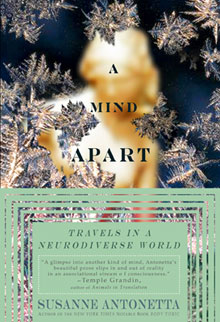
"A Mind Apart : Travels in a Neurodiverse World" by Suzanne Antonetta.


To say that I found this book mind expanding would be an understatement. Susanne Antonetta shares her own story of having manic depression as she explores our neurodiverse world, providing an illuminating perspective on mental health. I really like that Susanne Antonetta has friends from all over the spectrum. It is evident that she values and respects each one and, as she introduces her reader to Dawn and N'Lili, so do we.

Coming from my place of anxiety I also found this book to be very comforting. The author manages her manic-depression with medication. She is talented, creative
, successful, and has a rich life and a loving family. In a world where stigma is still attached to mental health problems she has the courage to write about herself and her experiences. The world is fortunate indeed to have such a gifted writer, mother, friend, teacher. The journey she writes about was filled with suffering and confusion, but who's isn't? Certainly not mine, and probably not yours. And so I apply these lessons to my own friend over whom I fret so much, for who am I to wish they were other than how God made them?

Saturday, January 16, 2010

What It Looks Like From Here, Part 1


St. Jude
4.25 x5.25 gouache on paper


I base all of my St. Judes on my brother Wally. Wally was born with autism, developed grand mal seizures as a child, and was diagnosed with ALS in 2003. Life has been very hard for my brother, and it has been hard for the people who love and care for him. Born at a time when no one yet understood the mind of the non-verbal autistic child he was labeled as "severely mentally retarded". My parents were told that he would never progress, would never understand anything they said, and were advised to place him in an institution. Fortunately, although they were young parents charting completely unexplored territory, institutionalizing their son was simply not an option for my parents. Given the option of dumping my brother (and parents back then were encouraged to do it) they chose the harder road.

I've written a lot about my brother Wally. I absolutely love him and I am so proud of him and all that he has accomplished. I am also very grateful to my parents for sticking by him. They are good people who did their best under immense stress and pressure. Were they perfect? Of course not. If your parents are perfect then you'd better check the basement for pods. Being perfect is not what is required. The ability to grow, to change and adapt and enlarge your spirit is. And my parents had to achieve this in the midst of what often felt like a disaster zone. So this time, I'm going to write about the rest of us.

First off, looking back on my childhood, there was not much grace and dignity. That comes later. I remember the chaos of Wally's seemingly endless bouts of screaming and throwing himself on the floor, his destruction of anything that wasn't nailed down (and some things that were), and the fear that he would bolt into the road and be killed by a car or stick his arm into the washing machine and break it to pieces because he was fascinated by the spin cycle, and how we had to constantly guard the kitchen because anything he got a hold of-raw chicken included- he would swallow whole. I remember the sadness, the frustration, and the anger swirling around. I think we all went through periods of depression, Wally especially. Where was this all leading? What would happen to Wally? Would it ever get any better? Any easier? We were in the soup up to our eyeballs, living from wet bedding (mine included) to food grabbing to grand mal seizures to angry loud knee jumping and yelling all day and night....you get the picture.

My Mom was a stay at home mom. My Dad was ALWAYS at work. ALWAYS. Among the first conversations I remember my parents having is my Mom saying "You're not going in, are you? It's Sunday!" and my Dad saying something about something he had to do. I also remember my Mom calling my Dad, who worked just up the road at the family business, and telling him dinner was ready and Dad not coming home. It was this whole big thing. My Mom got so mad she pitched his supper out the door one evening. Even though I was too little to really understand it was evident that my mom felt abandoned.

I think that any parent of small children would feel unsupported if their spouse put work ahead of family time, but for my Mom the stakes were higher. Among my first memories is Wally, red faced and screaming, lying on his back on the living room rug with his knees bent under him and his back arched in an impossible curve, obviously in terrible pain. Mom and I stood by helplessly as that raw, animal sounding screaming just went on and on, and Mom was just beside herself. He would stop, eventually, but not until my poor Mom had run the emotional gamut and was completely wrung out and I was sick with fear. If my Mom felt so out of control then anything could happen to me. I didn't feel safe.

My Mom worked really hard at trying to help Wally feel better. Way before there was an internet she found as much information as she could. She learned all about food allergies, food additives, and the evils of processed foods and refined sugar. Long before it was cool we were eating tofu and wheat germ and home made bread. My Mom put up with my and my older sister's loud complaints over this state of affairs and did not waiver from her course. She learned about the connection between autism and gastric distress, about seizures and what could trigger them. She left no stone unturned. She is a testament to determination and the kind of mother love that is in it for the long haul and I am in awe of her. Even when she was tired and angry and sad she tried and tried.

When my brother almost died due to the ALS that has wasted his body I saw on her face such sorrow and resignation. "He's gone," she said softly. I could tell that she had been privately preparing herself for this. My Mom has become, since those early, crazy days, calm and stoic in the face of crisis. It has often occurred to me that she has not only had to witness her son physically suffer his whole life but has had to watch over his safety the way you look after a toddler, only for forty plus years instead of the usual three or four. As Wally's behavioral problems have waned and his physical needs have increased exponentially-he is now using a trach, vent, and feeding tube- our Mom has remained as dedicated to his care and to doing everything she can to help him stay in optimal health as she always has. Even now, she leaves no stone unturned.

This past Christmas I was looking through a batch of wrapping paper that had come from my Gramma Sara-who saved everything- and I found a piece that instantly brought me back to the Christmas my Mom used it to wrap all of our gifts. It is really pretty, but a certain kind of pretty that I'll always associate with my Mom. I remembered the way she would see a certain something and say -"I like that!" and I would be pleased because she was pleased. Looking at that pretty piece of wrapping paper that I so completely identified with my mother, I remembered how I always noticed, every year, what she had chosen to wrap our gifts. Even when I believed in Santa Claus I knew that wrapping paper was all Mom. She always chose something that was so right. And that made me think of how she always made everything so nice. She made our house pretty, she brought us to museums, she found the best place to have lunch in Saratoga Springs and would take my sister and I there, and she always loved every little thing I ever made, and made sure I had all the art supplies I needed. It occurs to me now how much strength and generosity of spirit it took to do these things in the face of her child's disability, a disability that by it's nature was so huge it unrelentingly pervaded every aspect of her life with no indication of letting up. Ever.

I don't know if Mom ever prayed to St. Jude, but she didn't give up in the face of a seemingly hopeless situation. I don't know how she did it. The choices she made, and everything that happened good and bad have proven to be the biggest gift she could ever give to her children. When you grow up watching the adults in your life grapple with the seemingly impossible, when you see them at their worst and you see them at their best, when you watch them try, when you watch them surrender, you learn a lot. When you watch them not be perfect, when you watch them grow and change, you learn a lot. When they show you a capacity to love that is so huge it weathers anything, and I mean anything, you learn a lot. If you are paying attention, you can put what you've learned to good use, and therein lies the ultimate gift our parents give to us, if we can see it clearly.

Furthermore, because my Mom is the woman she is my brother survived, and does until this day, and this is yet another gift she has given us, years in the making, one hard day after another.

Thank you, Mom.


Tuesday, December 8, 2009

It Is What It Is


St. Eugene de Mazenod
Patron Saint of Dysfunctional Families
mixed media shrine


Last year I told my husband that if we were rich we could leave the country during the holiday season and escape to some place where they've never heard of Christmas. Christmas has been kicking my ass for years. About ten years ago I decided that enough was enough, and every year since then I have been letting go more and more of all of the deadline induced anxiety and guilt induced panic. I've been examining all of the weird capitalist driven hype surrounding the (not even his actual) birthday of Jesus Christ, the most socialist, egalitarian, non-materialistic holy person to ever walk the earth. I've deconstructed the crazy messages foisted on us by our unrelenting capitalist economy, like that a sweater bought at the Gap for Christmas is somehow much better than that same sweater all of the other 364 days of the year, and that the actual Spirit, the Real Meaning of Christmas can in fact be purchased, wrapped, and imparted to the recipient in the form of that sweater from the Gap! They will actually experience a warm, happy glow and hear tinkling bells, and they will love you for it. Yeah, I've been actively deprogramming myself, and I've been trying to figure out how to celebrate Christmas in a way that is meaningful to me. I've been very frank with myself about being realistic with my time and resources. And that is all great. Year by year I've been letting go more and more. But there is something I struggle with every year, and that is not how I do Christmas, it is with whom I do Christmas. Which is what this blog is really about.


U R TOAST
detail of St. Eugene de Mazenod shrine


I suspect that the average person feels really, really bad at Christmas. Because the perception is that everyone else's family is having a Christmas card picture perfect jolly old heart warming time of it from November until January. Everyone except us, that is, with our alcoholics, weirdo recluses, co-dependents, martyrs, people prone to angry outbursts, the dead who we miss terribly, and those who choose to be estranged. Somehow it seems so important that on this one day everybody be who they are not, and this big Christmas expectation can condense and intensify our feelings of sadness, loss and disappointment about what is lacking in our family relationships into crisis proportions. I also suspect that the reason for all of the crazy doing, spending, and rushing around is that it serves as a huge distraction from how bad we feel. Because, let me tell you, the less crazy Christmas doing I do, the more painful feelings I have to get through about my family relationships.


"Old Great-Grandad Booze"
detail of St. Eugene de Mazenod shrine

That being said, a step back and a look at the big picture is in order. I believe that each person was purposely put upon the earth for one, or some, or all of these reasons: to teach, to learn, and to witness. I believe that I could not possibly be the person I am without my family: all that is good, all that is bad, and everything else has made me grow. I am discovering that when I stay rooted in what is I am not derailed by sadness over what is not. It has been a hard lesson to learn—forty years in the making—that I have been spending the holidays with the idea of who I want my family to be as opposed to who they are. I love them and accept them in sickness and in health, in absence and in presence, in grumpiness and in shame inducing nagging all of the other 364 days of the year in varying degrees of compassion (on a 0-10 scale). Yet on Christmas I expect some facsimile family. They don't exist. And they always disappoint me. Not like my real family, from whom I know exactly what to expect and who are consistently themselves, December 25th or no. And so I must own, that they were not screwing up my Christmases, I was. Thank God I am finally getting a handle on why Christmas kicks my ass. And so my plan this year for serenity, sanity, and hopefully enjoyment is as follows:

1. I will practice this wisdom from the Dalai Lama: " I am open to the guidance of synchronicity, and do not let expectations hinder my path."

2. I will remember these wise words from St. Milarepa, himself the child of a dysfunctional family: "I have understood this body of mine to be the product of ignorance, composed of flesh and blood and lit up by the perceptive power of consciousness. To those fortunate ones who long for emancipation it may be the great vessel by which they may procure Freedom. But to the unfortunates who only sin, it may be the guide to lower and miserable states of existence. This our life is the boundary mark whence one may take an upward or downward path. Our present time is a most precious time, wherein each of us must decide, in one way or other, for lasting good or lasting ill." (emphasis mine)

3. I will pray. A lot. Especially to St. Eugene de Mazenod, the patron saint of dysfunctional families. I will ask him to look over us and to help me detach with love.

4. I will talk my husband's ear off, and the ears of my other trusted friends, so that I can stay centered, see the big picture, and not be ruled by my feelings.

St. Milarepa
mixed media shrine


I think I can reasonably expect to survive.


Tuesday, November 24, 2009

Art Show- Opening November 27th!


My husband and I are having an art show! We will be hanging a lot of new work, and the gallery is also full of wonderful work by other area artists and crafters! I hope you can stop in and support a great independent local business!

Saturday, November 21, 2009

St. Valentine, Patron Saint of Lovers


St. Valentine, Patron Saint of Lovers
mixed media shrine


I have been watching the struggle for marriage equality for gay and lesbian couples with my heart in my mouth. Every time a marriage equality law is passed I rejoice, every time that law is struck down I am deeply sickened. For one group of people to enjoy a basic human right, and then for that same group to very self righteously work to DENY another group of people enjoyment of that right is so small minded. So puny of heart, so limited of spirit. So scary.

Because people who allow themselves to exist in a small minded state of being are the cause of the world's suffering. They might be perpetrating violence. They might be buying into some ugly rhetoric. They might be standing by cheering while their neighbor is dragged into the street and shot. They might be lobbying elected officials to violate the constitutional and human rights of their fellow citizens. Persecution takes place the world over. Persecution is universally recognized as WRONG unless a person is really and truly some huge asshole (the word asshole here symbolizing a spiritual void which is really, really ass). For example: the persecution of the Palestinian people by the Israelies, the persecution of Jewish people by Christians, the persecution of black people by white people, of Southern Sudanese people by Northern Sudanese people, of Native American people by white people, of Mexican immigrants in the U.S. by white people. How about women, children, and people who are poor who are exploited and/or denied justice by fundamentalist religions or rapacious capitalism (Marshall Islands, Tom Delay, sweatshop slavery-Google it)? How about political persecution? The list could go on and on. All heinous examples of one group of people who have some power or advantage being total assholes to somebody else. The denial of equal rights for gay people is no different. There is no justified reason to deny gay people equality. There never is any rational reason for this sort of miserable human failing. There is only fear, ignorance, hatred of one's self turned outward, and greed.


And if I hear the phrase "defense of marriage" ever again as a rallying cry to rob gay people of their right to marriage, I'm going to throw up in my mouth. Seriously. Because that is the most specious argument I have EVER heard. A fifty percent divorce rate would seem to indicate that straight people haven't been doing such a hot job with their God given right to wed, don't even mention the statistics on marital infidelity. Domestic violence, substance abuse, co-dependency, failure to rectify family dysfunction and lack of self knowledge are all killers of straight marriages. Gay people? Not so much.

I will end with this beautiful passage from the Bible, first Corinthians, chapter 13. It reminds us that love is the way in which God intends us to exist. That love is expressed through our way of being, our intentions, words, and actions. It also makes very clear what love is NOT:
"If I speak in human and angelic tongues but do not have love, I am a resounding gong or a clashing cymbal.
And if I have the gift of prophecy and comprehend all mysteries and all knowledge; if I have all faith so as to move mountains but do not have love, I am nothing.
If I give away everything I own, and if I hand my body over so that I may boast but do not have love, I gain nothing.
Love is patient, love is kind. It is not jealous, it is not pompous, it is not inflated,
it is not rude, it does not seek its own interests, it is not quick-tempered, it does not brood over injury,
it does not rejoice over wrongdoing but rejoices with the truth.
It bears all things, believes all things, hopes all things, endures all things.
Love never fails. If there are prophecies, they will be brought to nothing; if tongues, they will cease; if knowledge, it will be brought to nothing.
For we know partially and we prophesy partially,
but when the perfect comes, the partial will pass away.
When I was a child, I used to talk as a child, think as a child, reason as a child; when I became a man, I put aside childish things.
At present we see indistinctly, as in a mirror, but then face to face. At present I know partially; then I shall know fully, as I am fully known.
So faith, hope, love remain, these three; but the greatest of these is love.

I believe that to deny gay people the right to wed is to work against love. I believe that to work against love is to work against God.

Amen.

Monday, November 9, 2009

St. Dymphna the Protector


St. Dymphna the Protector
Gouache on paper 6" X 7.25"


I made this painting to thank St. Dymphna, and to honor her works in the lives those of us who ask for her help. I was moved to make this painting because of the following incident:

There is a person whom I am deeply concerned for. Being a recovering co-dependent, I have learned that worry is wasted energy, but that prayer is pro-active. There was a particular day several months ago when my sadness and concern felt so pointed that I prayed very intensely and with great focus.

I asked St. Dymphna to keep this individual in her care, to help them see their path, and to bless them with peace and joy. I asked her to help them see that their being is a beautiful miracle, and to not let them be overcome by despair. From nowhere, the scent of flowers wafted over me.

I glanced around me. It was not just the lovely smell of roses, it was the movement in the air, that it came from a direction, as though from a presence, that got my attention. It was not bloom time, the windows were closed, there was nothing near me-flowers, candles, incense- that would cause this scent. No one was home but my baby daughter (asleep on my lap), my dog (asleep at my feet) and I. I wasn't wearing perfume, and I have to use plain soap, but I sniffed my clothes just in case. Nope, not my clothes. I breathed in again. The scent was so present, yet so inexplicable. Then I knew: I was receiving a message, my prayer had been heard. Things like this just never happen to me, and I felt deeply grateful and very blessed. In making this painting I hope to share with others the peace and comfort I felt that day.


I surrounded the figures with oak leaves and branches, to symbolize the strength we need to overcome our wounds. St. Dymphna is guarding the person's light, making sure it is not blown out by the storm that surrounds them. The words around the border are St. Dymphna's message: " Heal. Live. Remember you are loved. Remember to take care of yourself."

The truth is, that I need these words, and I need St. Dymphna's help, just as much as my friend does. To love and care about a person with an unresolved mental health issue is a practice in faith, in turning it over to my higher power and letting go of fear every day.